I was helping a church with their audio setup when they asked me a question I hear all the time: what’s the best DI box for bass? Before I could answer, I asked their band to play a bit so I could hear what we were working with.
Something wasn’t right. The bass guitar had no low end – it sounded thin and weak. And their Nord piano, which should sound fantastic, was lifeless and hollow through the PA. Neither instrument sounded anything like it should. I knew it wasn’t the PA, because music through the sound system was full range and sounded great.
After some troubleshooting, I found the culprit: the DI box. Specifically, a Pyle PDC21 with the attenuation switch engaged. I swapped that DI box out for a Radial DI box that I had in my Pelican case and all of the tone came back from the bass guitar.
What I discovered with Smaart measurements surprised me – and it’s a lesson worth sharing if you want to find the best DI box for bass, keyboards, or any instrument.
What a DI Box Should Do
A DI Box (direct injection box) converts an unbalanced, high-impedance instrument signal to a balanced, low-impedance signal that can travel long distances to your console without picking up noise. For a deeper dive into balanced vs unbalanced connections, check out my guide: Balanced vs Unbalanced Audio: What’s the Difference and Why It Matters.
A quality DI box should do this conversion transparently – what goes in should come out sounding the same, just converted to a balanced signal. The frequency response should be flat from 20 Hz to 20 kHz. Letting the instrument create the tone the audience should hear.
What I Found with Smaart Measurements
To understand what was happening with that Nord piano and bass guitar, I set up a test rig with Rational Acoustics Smaart. I converted the output of my measurement system to high-impedance (simulating a keyboard or bass output), ran it through each DI box, then measured what came out the other side.
The Radial DI Boxes: Flat as Expected
First, I tested in my opinion the best inexpensive DI Box, the Radial StageBug SB-1 (active) and my other favorite DI, the Radial ProDI (passive). Both showed exactly what you want to see – a flat frequency response from 20 Hz all the way up to 20 kHz.
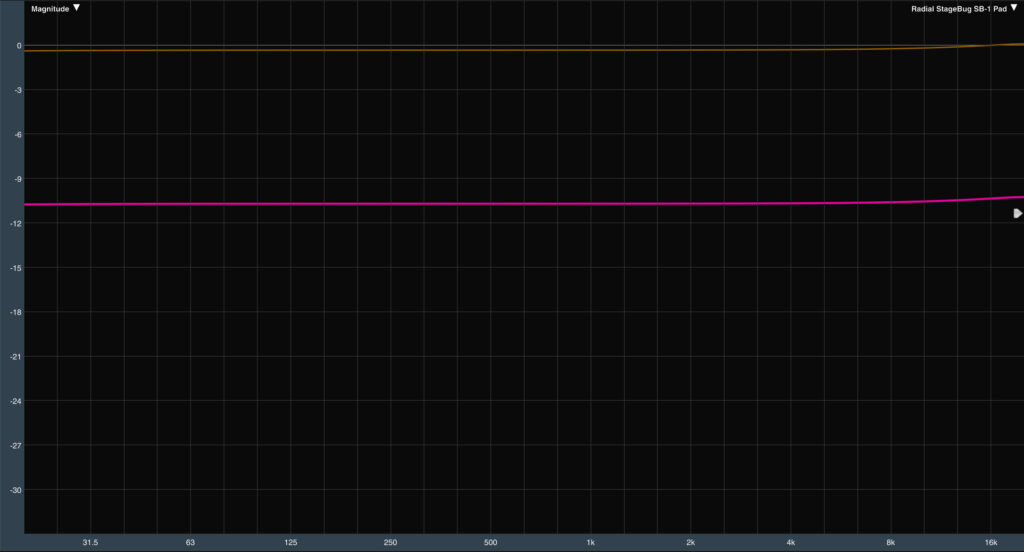
The Radial StageBug SB-1 maintains flat frequency response across the entire audio spectrum
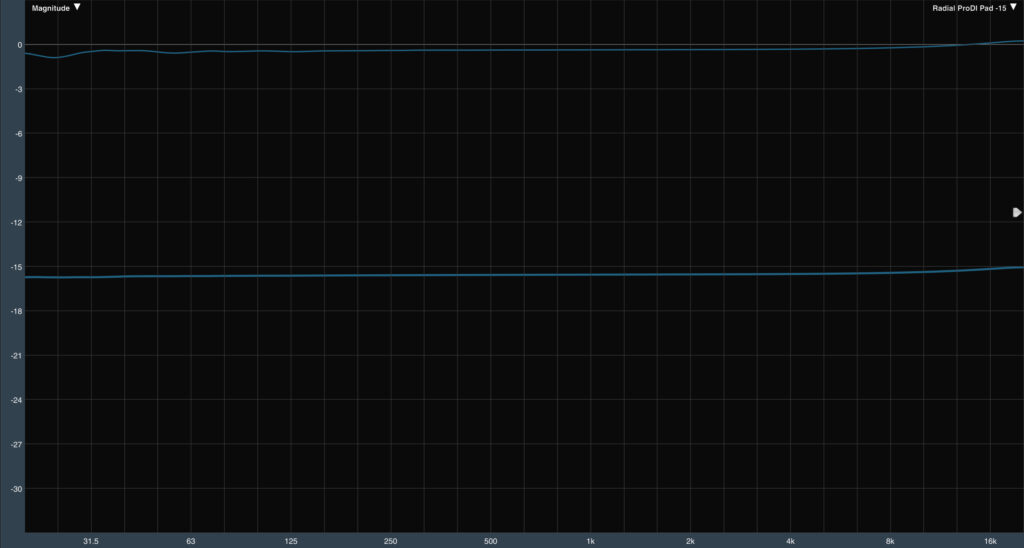
The Radial ProDI also shows flat response – no coloration to your tone
Even with the pad engaged on both Radial units, the response stayed flat – just attenuated evenly across all frequencies. That’s exactly how a pad should work.
The Pyle PDC21: Where Things Go Wrong
The Pyle PDC21 measured fairly flat with the attenuation switch off. But when I engaged the 20 dB pad – the same switch that was flipped on that church’s Nord – the results were dramatic.
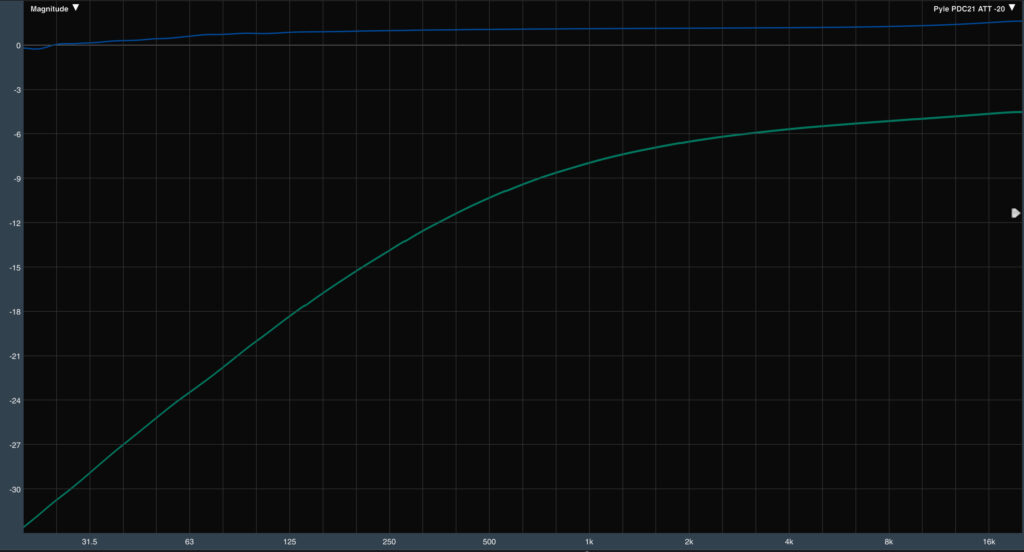
The Pyle PDC21 with attenuation engaged shows severe low-frequency rolloff
Instead of a flat 20 dB reduction across all frequencies, the measurement showed a first-order high-pass filter centered around 840 Hz with a -6 dB per octave slope. Here’s what that looked like in practice:
- At 5 kHz: approximately -5 dB (close to flat)
- At 1 kHz: approximately -8 dB
- At 125 Hz: approximately -18 dB
- At 30 Hz: approximately -30 dB
- At 20 Hz: approximately -32 dB
The pad wasn’t just turning down the signal – it was removing all the low end. No wonder that Nord and bass guitar sounded thin and lifeless. The entire bottom half of the piano and bass guitar was being filtered out before it ever reached the console.
Why Does This Happen? (geeky details)
A passive DI box uses a transformer to convert the signal. The transformer’s low-frequency response depends on its primary inductance and how it’s loaded. In a quality DI box like the Radial ProDI, the transformer has enough primary inductance (and the pad is designed properly) so the low-frequency response stays flat even when attenuated.
In the Pyle PDC21, engaging the pad appears to dramatically change the impedance and loading seen by the transformer. This shifts what’s called the high-pass corner frequency way up into the audible range – right around 840 Hz in my measurements. The result is that classic “where did my low end go?” sound.
This isn’t a problem with all passive DI boxes – it’s a design and component quality issue. A well-designed passive DI with a quality transformer handles attenuation without sacrificing low-end response.
The Audio Difference
The Smaart measurements tell the story, but hearing is believing. In my video, I demonstrate acoustic guitar, bass, and keyboard through both a Radial StageBug SB-2 and the Pyle PDC21, both passive DI Boxes, and I had the attenuation engaged. The difference is immediately obvious – the Radial sounds full and natural, while the Pyle sounds thin and hollow.
[VIDEO EMBED]
Troubleshooting Tip: Swap Your Gear
Here’s a lesson I’ve learned over the years: if something sounds wrong and you can’t figure out why, try swapping out the gear in the signal chain. I’ve encountered bad-sounding cables, DI boxes, microphones – you name it. Sometimes a piece of gear just isn’t performing the way it should.
If you’re mixing a keyboard or bass guitar and it sounds thin or weak no matter what you do with EQ, check the DI box. Try a different one. You might be surprised to find that the “problem instrument” was actually a problem DI box all along.
Active vs Passive: Which Should You Use?
This brings up a common question – when should you use an active DI versus a passive DI?
Use a passive DI when the instrument has active circuitry, like a keyboard or an active bass guitar. These instruments have gain stages built in and output a higher level signal. A quality passive DI handles hot signals gracefully, and I’m always trying to reduce the number of gain stages in an audio system to keep noise to a minimum.
Use an active DI when the instrument is passive, like a bass guitar with passive pickups or an acoustic guitar, a violin or banjo that have piezo pickups. Active DI boxes typically have very high input impedance (1M ohm or higher), which helps load the instrument properly and preserve the tone – especially the high-end clarity and transient punch that passive pickups need.
The rule of thumb: passive instrument → active DI. Active instrument → passive DI.
Recommended DI Boxes
If you’re looking for reliable DI boxes that won’t compromise your tone, the Radial StageBug series is a great starting point:
- Radial StageBug SB-2 – Passive DI, great for keyboards and active instruments
- Radial StageBug SB-1 – Active DI (requires +48 V phantom power), ideal for passive bass and acoustic guitars
For more DI box recommendations including premium options, check out my complete guide: All About DI Boxes
The Bottom Line
Not all DI boxes are created equal. A cheap DI box might work fine in some situations, but as my Smaart measurements show, engaging certain features (like a pad) can dramatically alter your frequency response in ways you don’t expect.
If you’re investing in quality instruments and a quality console, don’t let a $15 DI box be the weak link in your signal chain. A good DI box from a reputable manufacturer will serve you for years and ensure your instruments sound the way they’re supposed to.