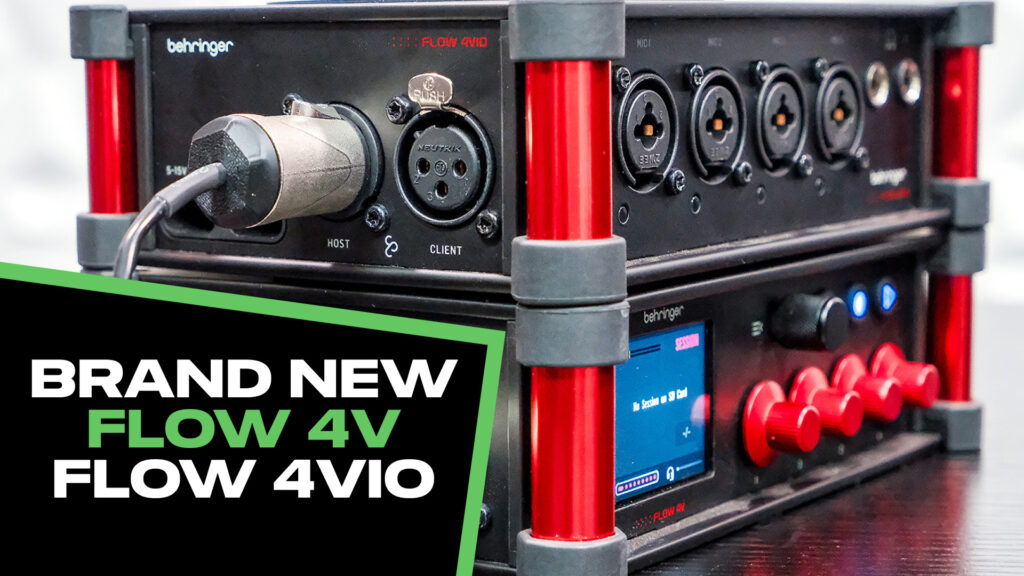
Behringer just dropped two new products that don’t fit neatly into any single category – and that’s exactly what makes them interesting. The Behringer Flow 4V ($299) and Behringer Flow 4VIO ($229) are field recorders, USB audio interfaces, and StageConnect I/O boxes all in one. Whether you’re recording video content, streaming from your desk, or running live sound with a Behringer WING, these units have something to offer.
Here’s everything you need to know about the Behringer Flow 4V and Behringer Flow 4VIO – what they do, how they work together, and whether they make sense for your setup.
What Makes These Different: Dual-Stage Preamps and 32-Bit Float
Before we get into the specifics of each unit, we need to talk about the technology that makes both the Behringer Flow 4V and the Behringer Flow 4VIO stand out – dual-stage preamps paired with 32-bit float recording.
If you’ve ever set gain on a traditional preamp, you know the balancing act. Set it too low and you get noise. Set it too high and loud moments clip. You’re constantly trying to find that sweet spot where you capture enough signal without risking distortion on peaks.
The dual-stage preamp design in the Behringer Flow 4V and Flow 4VIO takes a different approach. Instead of a single gain stage that you have to set perfectly, these preamps use two stages optimized for different signal levels. The result is 142 dB of dynamic range (A-weighted) – enough to capture everything from a whisper to a scream without clipping or noise.
Combined with 32-bit float recording, this means you can essentially “fix it in post.” Even if a signal looks clipped on the meter, the 32-bit float file contains all the detail you need to pull it back down in your DAW. No more ruined takes from unexpected loud moments.
One thing to note: this doesn’t mean you can ignore levels entirely. You still want reasonable gain staging for the best results. But it does mean you have a massive safety net, which is incredibly useful for run-and-gun video production where you can’t always ride the faders.
Behringer Flow 4V: The 10-Track Field Recorder
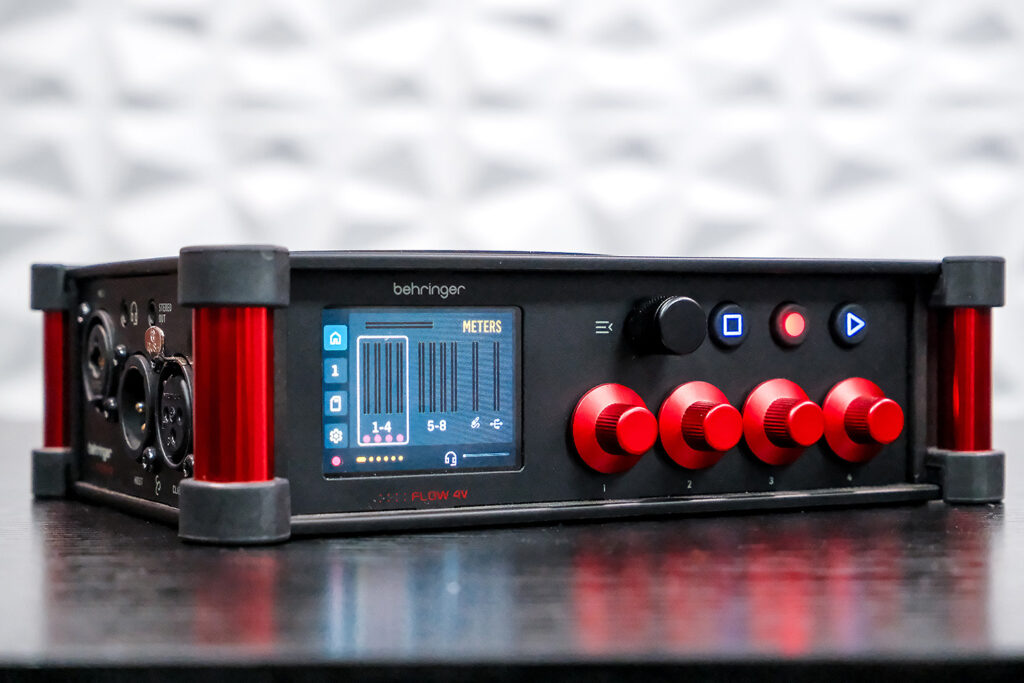
The Behringer Flow 4V front panel with touchscreen, transport controls, and channel level knobs
The Behringer Flow 4V is the main unit – a 10-track field recorder with a touchscreen interface and transport controls.
Recording Channels Explained
The “10-track” designation can be confusing, so let’s break down exactly what gets recorded to the SD card:
| Channels 1-4 | Local XLR/TRS inputs on the Flow 4V |
| Channels 5-8 | StageConnect inputs (from a connected Flow 4VIO) |
| Channels 9-10 | AUX input (stereo 1/8″ TRS) |
| Channels 11-12 | USB or Bluetooth input (stereo) |
| Channels 13-14 | Bluetooth talkback (stereo) |
| Channels 15-16 | Main mix (stereo) |
So while it’s marketed as a 10-track recorder, you can actually record up to 16 channels when you add a Flow 4VIO and enable all the sources. The SD card uses FAT32 format, and the Flow 4V can format cards up to 32 GB directly on the device. Larger cards do work, but need to be formatted as FAT32 on a computer before use. Behringer recommends formatting the card before starting a new recording series to avoid fragmentation issues.
Physical Layout of the Behringer Flow 4V
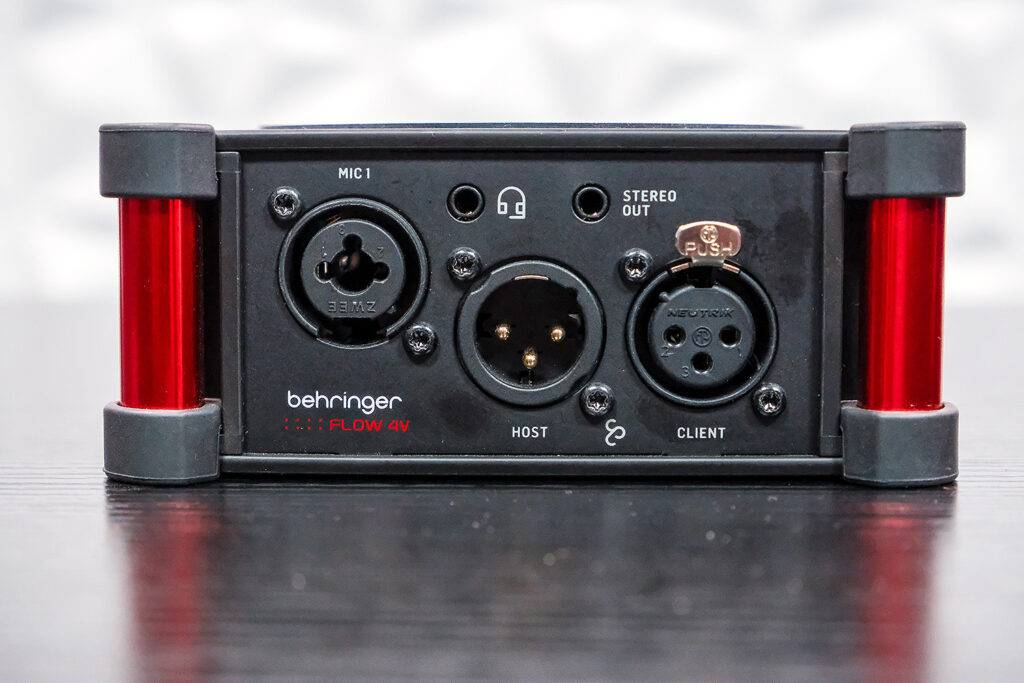
Left side panel: Input 1, headphone/talkback jack, stereo output, and StageConnect ports
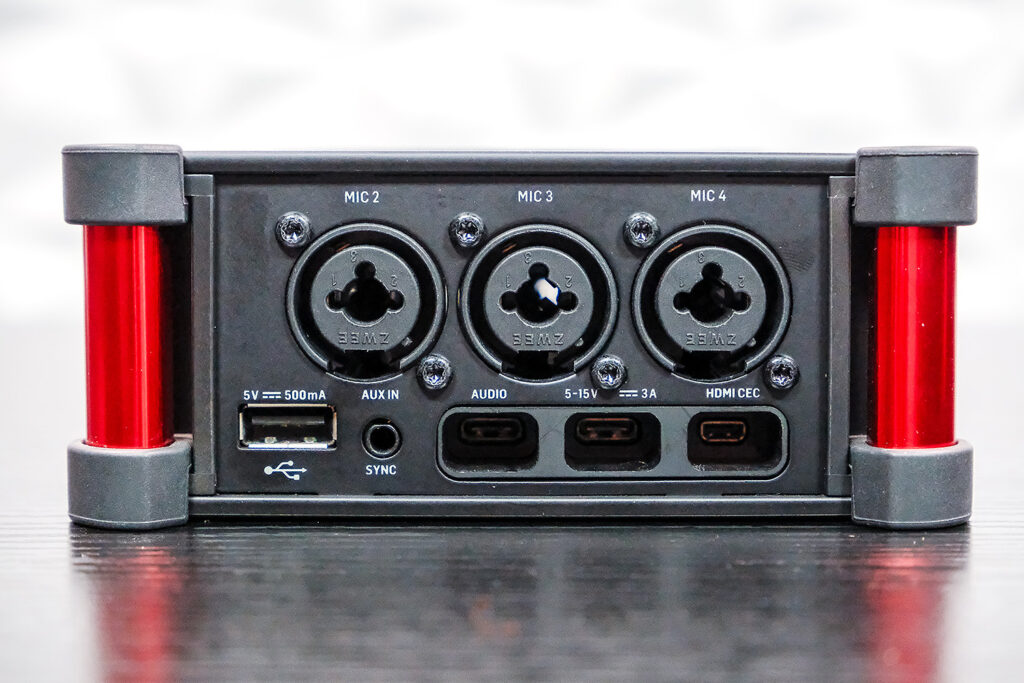
Right side panel: Inputs 2-4, USB-A backup port, AUX in, USB-C ports, and Micro-HDMI
The Flow 4V packs a lot of connectivity into a compact form factor (184 mm × 128 mm × 53 mm, about 800 g). Here’s what you’re working with:
Inputs:
- 4 XLR/TRS combo jacks with 48V phantom power
- 1/8″ stereo AUX input (also doubles as timecode sync input)
- 1/8″ TRRS headset jack (includes mic input for talkback)
- Bluetooth audio input
- USB audio input (2 channels from computer)
Outputs:
- 1/8″ stereo output (for feeding camera audio input)
- 1/8″ TRRS headphone output
Other Connections:
- StageConnect HOST and CLIENT ports
- USB-C audio/power port (can power the unit when connected to a computer with USB-PD)
- USB-C power-only port
- USB-A port for automatic backup to flash drive
- Micro-HDMI for camera sync (HDMI-CEC)
Key Specs for the Behringer Flow 4V Inputs
The preamps deliver impressive performance across the board:
- Dynamic range: 142 dB (A-weighted)
- EIN: -132 dBu (A-weighted)
- Max input level (XLR): +18 dBu
- Max input level (TRS): +29.5 dBu
- Max gain: +70 dB
- Phantom power: 48V switchable
That +29.5 dBu max input on TRS is worth noting – it’s significantly higher than the XLR input, which makes TRS the better choice for hot line-level sources.
Standout Features
HDMI-CEC Camera Sync: Connect the Flow 4V to your camera via Micro-HDMI, and it will automatically start and stop recording when your camera does. No more forgetting to hit record on your audio. Not all cameras support this, so test it with your specific setup before relying on it for production.
Pre-Roll Buffer: When enabled, the Flow 4V continuously captures the last 5 seconds of audio. Press record slightly late? The pre-roll buffer has you covered.
Automatic USB Backup: Insert a FAT32-formatted USB flash drive into the USB-A port, and every time you stop recording, the Flow 4V automatically backs up that take to the flash drive. No manual steps required.
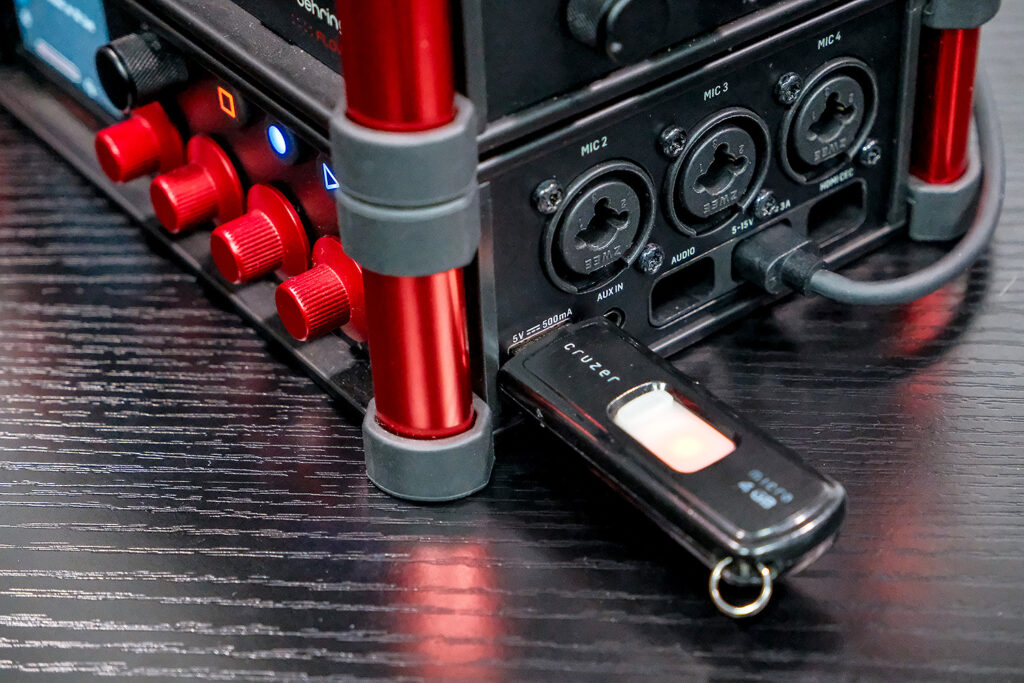
USB flash drive inserted for automatic backup – a simple but valuable safety net
Bluetooth Remote Control: The Flow 4V MIX app (iOS and Android) lets you control the unit remotely via Bluetooth. You can also receive talkback audio and playback from mobile devices over Bluetooth.
Timecode Support: Three modes available – Rec Run (resets each take), Time of Day (matches clock), and Free Run (continuous).
Channel Processing
Each of the 8 input channels (4 local plus 4 via StageConnect) gets its own processing:
- High and low cut filters
- Tone EQ (one-knob tilt EQ)
- Dynamics (choose one): expander, one-knob compressor, or limiter
- Pre-fader delay for time alignment
The main mix bus adds a 3-band EQ, limiter, and post-fader delay for syncing audio to video.
There’s also an automixer that supports up to 8 channels – useful for panel discussions or interviews where you want automatic gain sharing between multiple mics.
Behringer Flow 4VIO: The Expansion Box
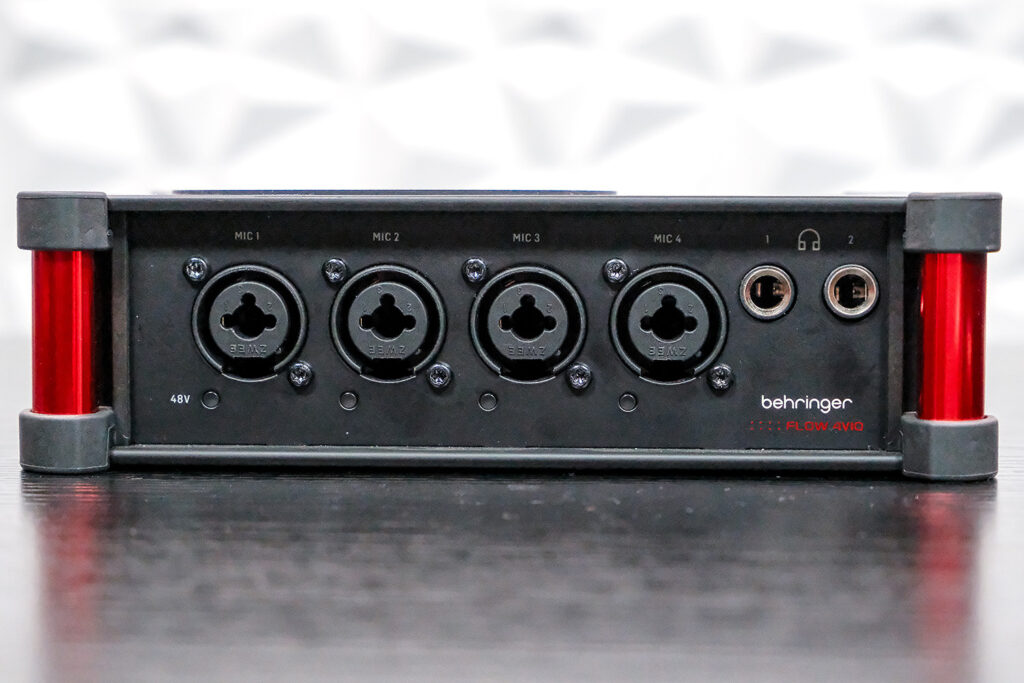
The Flow 4VIO front panel with four XLR inputs and two 1/4″ headphone outputs
The Flow 4VIO is simpler than the 4V – no screen, no transport controls, no SD card recording. But that simplicity is the point. At $229, it’s an affordable way to add 4 more inputs to your Flow 4V setup, or to use as a standalone USB interface, or to add I/O to a Behringer WING.
What the Behringer Flow 4VIO Offers
- 4 XLR combo jack inputs with +48V switchable Phantom power and with the same dual-stage preamps as the Flow 4V
- 2 dedicated 1/4″ TRS headphone outputs with individual level knobs (Max Output 72 mW at 30 Ω load, 0.005% THD+N)
- USB audio interface (4 in / 4 out standalone, or additional channels when paired)
- StageConnect HOST and CLIENT ports
Physical Layout
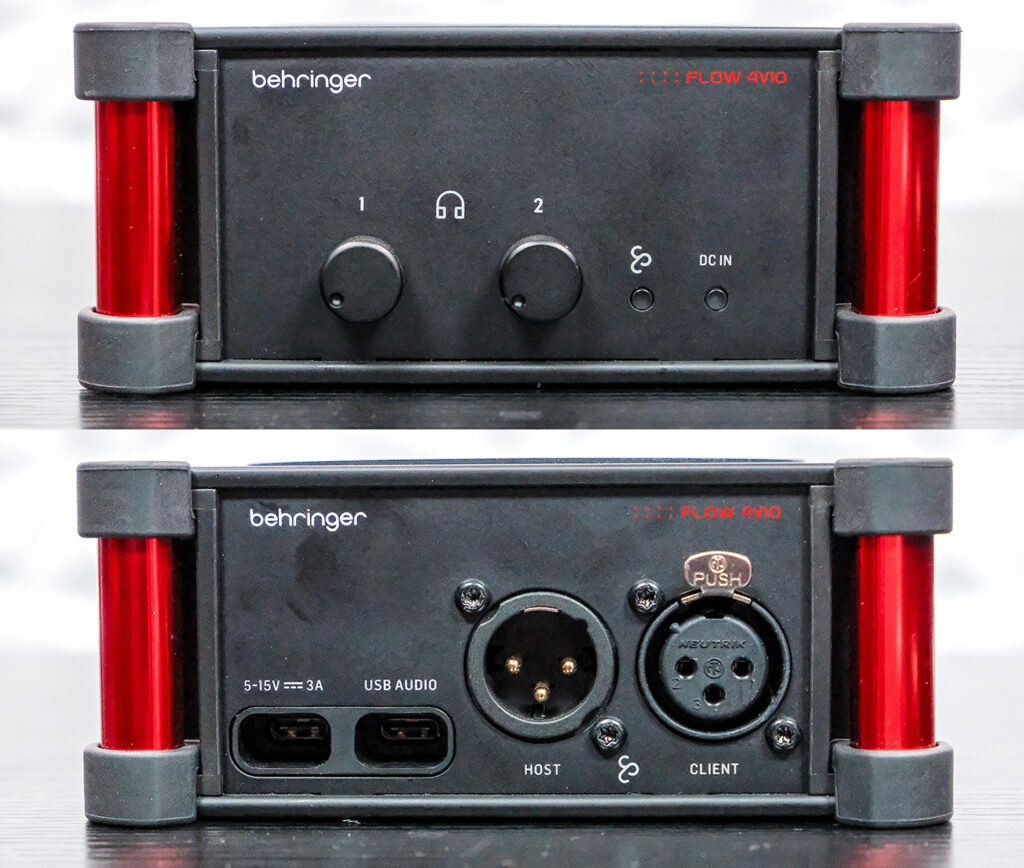
Behringer Flow 4VIO side panels showing USB-C ports, StageConnect ports, and dedicated headphone level knobs
The 4VIO matches the 4V’s dimensions exactly, so they stack together cleanly. The right side panel has two dedicated knobs for headphone output levels – a nice touch compared to the on-screen control on the Flow 4V.
The status LEDs on the 4VIO tell you what’s happening at a glance:
- StageConnect LED: Green = connected and working, Yellow = occasional transmission errors, Red = disconnected
- Power LED: Indicates DC power status
Using Them Together: Behringer Flow 4V + Flow 4VIO
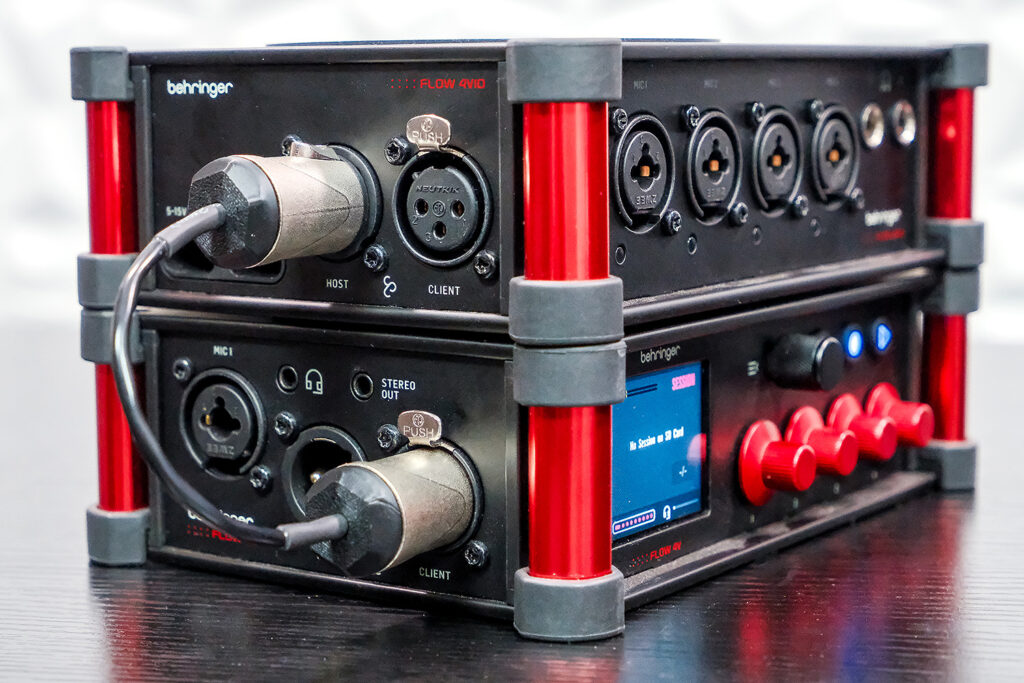
The Behringer Flow 4V and 4VIO connected via StageConnect – only one unit needs external power
When you pair the Behringer Flow 4V with a Flow 4VIO via StageConnect, you get an 8-input recording system with flexible monitoring options.
Power and Connection
Here’s the beautiful part: only one unit needs external power. Connect power to either the Flow 4V or the 4VIO, and the powered unit becomes the StageConnect HOST. The other unit receives power through the StageConnect cable and becomes the CLIENT.
This means you can:
- Stack both units together and power the FLow 4V (the Flow 4VIO gets power through StageConnect)
- Place the 4VIO on a mic stand closer to your sound source and run power to it (the 4V gets power through StageConnect)
Either way, one power supply handles both units.
Combined I/O
When paired:
- 8 total mic/line inputs (4 on each unit)
- 3 headphone outputs (1 on 4V, 2 on 4VIO)
- Up to 16 channels of SD recording
- 14 channels USB input / 4 channels USB output to computer
Monitoring Routing
When the 4VIO is connected to the 4V:
- 4VIO Phones Output 1: Mirrors the Flow 4V’s stereo output (main mix)
- 4VIO Phones Output 2: Mirrors the Flow 4V’s phones output (includes talkback)
This lets you give the producer a clean mix on Output 1 while the operator gets the talkback-enabled mix on Output 2.
Behringer Flow 4VIO with Behringer WING: A Complete Tracks Rig
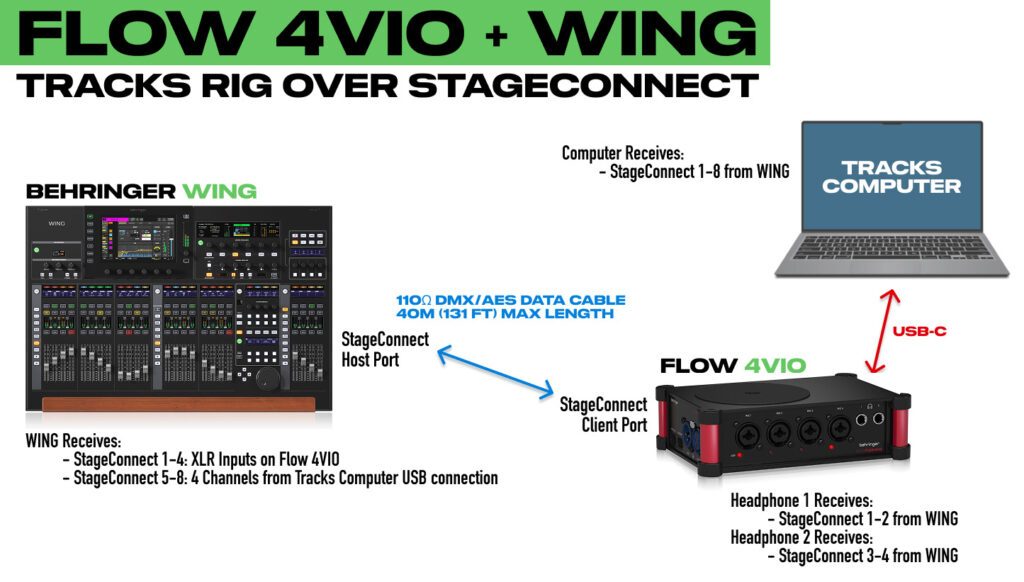
Here’s where things get interesting for live sound applications. The Flow 4VIO can connect directly to a Behringer WING via StageConnect – and when you add USB into the mix, you’ve got a complete tracks playback, talkback input and recording solution in a single box.
How It Works
Connect the Behringer 4VIO to your WING’s StageConnect port (WING is HOST, 4VIO is CLIENT). Then connect a computer to the 4VIO’s USB-C audio port. Here’s what you get:
Upstream to WING (8 channels):
- Channels 1-4: The 4VIO’s XLR mic inputs
- Channels 5-8: USB audio from your computer (backing tracks, click, cues)
Downstream from WING:
- Channels 1-4 route to 4VIO Phones Output 1 and 2 (artist monitoring, IEMs)
- Channels 1-8 available at the USB port (multitrack recording into your computer)
A practical tip: send SMPTE timecode down channel 5 from WING to your tracks computer. This keeps your show SMPTE in time with your Tracks playback.
So with one Behringer Flow 4VIO, one StageConnect cable, and one USB cable, you can:
- Send 4 mic inputs to WING
- Send stereo backing tracks and stereo click/cues to WING
- Feed two stereo headphone mixes for artist monitoring
- Record 8 channels of multitrack audio into your DAW
Daisy-Chaining for More I/O
You can daisy-chain two Flow units together with WING for even more I/O. WING connects to the first unit’s CLIENT port, then the first unit’s HOST port connects to the second unit’s CLIENT port. This gives you up to 16 upstream channels and distributed headphone outputs across two locations.
Here’s a practical application: two 4VIOs can support both your main tracks computer and your backup tracks computer. Your main tracks rig connects to the first 4VIO and receives downstream channels 5-8 from WING. Your backup tracks rig connects to the second 4VIO and receives downstream channels 13-16. Both rigs get the same playback feeds, giving you full redundancy.
Mounting and Portability
Both units share the same mounting system:
- Standard 1/4″-20 threaded mounting points for cameras and video equipment
- Anti-rotation holes for secure mounting
- Integrated captive screw on the bottom for stacking units together
- Included microphone stand clip (fits 5/8″ stands)
- 3 mm hex wrench stored behind the antenna (Flow 4V only)
The matched dimensions mean you can stack them cleanly – secure the 4VIO to the 4V using the captive screw, and the whole assembly mounts to your camera or mic stand as one unit.
Who Should Consider These?
Video producers and content creators: The Behringer Flow 4V is a compelling option if you need multitrack recording with 32-bit float safety, HDMI-CEC camera sync, and timecode support. The dual-stage preamps mean less stress about gain staging in unpredictable environments.
Podcasters and streamers: Either unit works as a USB audio interface. The Flow 4V gives you 12 inputs to your computer with onboard processing; the 4VIO gives you 4 inputs with two quality headphone outputs for host and guest.
Live sound engineers with WING: The Behringer 4VIO is an incredibly cost-effective way to add remote I/O and USB connectivity to your WING setup. For tracks playback, recording, and artist monitoring, it’s hard to beat in such a small box.
Anyone who needs flexible I/O: The ability to use these as field recorders, USB interfaces, and StageConnect I/O boxes – sometimes simultaneously – makes them adaptable to a lot of different workflows.
Check out the Behringer Flow 4V at Sweetwater or the Behringer Flow 4VIO.
Final Thoughts
The Flow 4V and 4VIO aren’t trying to be one thing – they’re trying to be useful in multiple contexts, and they largely succeed. The dual-stage preamps with 142 dB dynamic range address a real problem in field recording. The StageConnect integration opens up possibilities for WING users. And the USB interface functionality means you’re not buying a single-purpose device.
At $299 for the Behringer Flow 4V and $229 for the Behringer Flow 4VIO, the pricing is aggressive. A combined system with 8 inputs, 16-channel recording, and 3 headphone outputs runs $529 – less than many standalone field recorders with fewer features.
If you’re in the market for a field recorder, a portable USB interface, or additional I/O for your WING, these are worth a serious look.