If you’ve been running in-ear monitors for your band or worship team, you’ve probably used – or at least considered – Behringer’s Ultranet personal monitoring system. The P16-M has been a staple for years, and for good reason. It’s affordable, it works, and it lets your musicians control their own mix without driving you crazy at front of house.
But Behringer has expanded the lineup. The P16-HQ promises better audio quality and has replaced the P16-M. The Behringer P24 adds more channels giving stereo ability. And the Midas DP48 sits at the top with dual mix engines for two different musicians and AES50 connectivity. So which one should you actually buy?
I pulled all four units into my studio, connected them to my measurement rig, and put them through a number of tests using Rational Acoustics Smaart Suite. What I found confirmed some suspicions, surprised me in a few places, and gave me a much clearer picture of what you’re actually getting with each unit.
The Units
Before we dive into measurements, here’s what we’re comparing:
Behringer P16-M – The original. 16 channels, Ultranet connectivity, simple interface. This is what most people have been using for years.
Behringer P16-HQ – The “High Quality” replacement of the P16-M. Same 16 channels and Ultranet connectivity, but with an upgraded DAC (rated at 114 dB dynamic range) and a redesigned headphone amplifier stage.
Behringer P24 – 24 channels with StageConnect connectivity. More channels than the P16 series, with flexible routing options.
Midas DP48 – The flagship. 48 channels, dual independent mix engines (so you can create two completely different mixes), AES50 connectivity, and the Midas name. This is positioned as the premium option.
Behringer P16-HQ vs P16-M
If you have attempted to purchase a Behringer P16-M recently, you will find that you can only purchase them used. That is because the Behringer P16-HQ has replaced the P16-M. You can use both the P16-HQ and the P16-M in the same system together, either daisy-chaining them via Ultranet or with the Behringer P16-D distribution system allowing you to distribute power and Ultranet to eight P16 units without the need for wall warts at the P16 monitors. This replacement with an upgraded unit is what made me want to take a deep look at the P16-HQ vs P16-M, because the spec’s released by Behringer looked like a fantastic upgrade!
Test Methodology
I measured all four units using Rational Acoustics Smaart Suite, with each personal monitor connected via its respective digital connection – Ultranet through a Behringer SD8 (connected via AES50 from the WING) for the P16-M and P16-HQ, StageConnect from the WING for the Behringer P24, and direct AES50 from the WING for the Midas DP48. Smaart was interfaced with the WING via USB and the test signals were generated from Smaart. The test connections were on the Behringer WING and the reference was a physical loopback from an output on the WING to an input on the WING.
For the transfer function measurements, I used the headphone output feeding a Radial passive DI box, with a pair of Sennheiser IE 4 earphones (16 ohm) connected to the through jack as a realistic load. The DI output went to my Behringer WING for capture. Before testing the personal monitor mixers I verified that the Radial DI box used did not introduce any change for measurements.
I first sent pink noise to each unit and set the output volume to as high as it would go without engaging the limiter on the personal monitor mixers. I then left the volume knob at the same position for all the tests.
I tested the 20 Hz-20 kHz magnitude response with pink noise, the THD measurement with 1 kHz sine wave to analyze the harmonic content, and the self-noise measurement with no signal coming from the WING to measure the noise floor.
Note: I’m not a calibrated test lab
One thing to note: these measurements are comparative. I’m not a certified testing lab with calibrated equipment, but the relative differences between units are consistent and meaningful. My goal was to see how these units stack up against each other in real-world conditions.
Output Level Differences
Right off the bat, I noticed significant differences in how hot each unit runs at full volume.
Headphone Output Level @ 1 kHz (relative to reference):
| Unit | Output Level |
| Behringer P16-M | +2.1 dB |
| Behringer P16-HQ | 0 dB (reference) |
| Behringer P24 | 0 dB |
| Midas DP48 | -12.4 dB |
The Behringer P16-M runs about 2 dB hotter than the P16-HQ. The Behringer P16-HQ and Behringer P24 are identical – within measurement error of each other. The Midas DP48 runs significantly quieter, about 12 dB below the P16-HQ.
This doesn’t mean the DP48 is “weak” – it’s just calibrated differently. I noticed the limiter starts working at a lot lower level. But it does mean if you’re regularly swapping between units, you’ll need to account for these level differences.
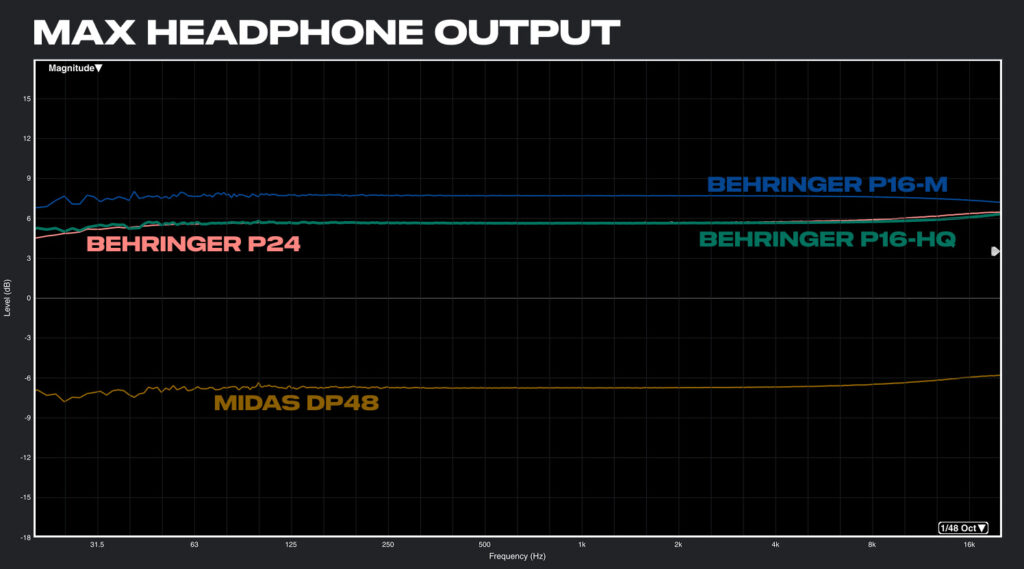
Max headphone output of the Behringer P16-HQ, Behringer P16-M, Behringer P24 and Midas DP48
It is also important to note that turning any of these units up to FULL is VERY loud in a set of headphones. No matter which personal mixer you go with, there is plenty of volume.
Noise Floor: Where the P16-HQ Really Shines
This is where things get interesting. I measured the self-noise of each unit at full volume with no input signal – essentially capturing how quiet the unit is when it’s just sitting there.
The Behringer P16-HQ is dramatically quieter than the Behringer P16-M.
Average Noise Floor:
| Unit | Avg Noise Floor | vs P16-M |
| Behringer P16-HQ | -144.7 dB | Reference |
| Behringer P24 | -143.0 dB | ~2 dB noisier |
| Midas DP48 | -140.0 dB | ~5 dB noisier |
| Behringer P16-M | -132.7 dB | 12 dB noisier |
Both the Behringer P16-M and P16-HQ share the same Ultranet protocol with its 92 dB typical dynamic range spec. But the P16-HQ features an upgraded DAC rated at 114 dB dynamic range, paired with a redesigned headphone amplifier. That converter and amplifier improvement shows up clearly in my measurements – the P16-HQ averages about 12 dB quieter than the P16-M.
But here’s what really matters for IEM users: low frequency noise. This is where you hear hum, rumble, and that low-end “presence” of noise during quiet passages in songs. At 20 Hz, the Behringer P16-HQ measured -161 dB compared to the Behringer P16-M at -126 dB. That’s a 35 dB improvement in the low frequency region where noise is most noticeable.
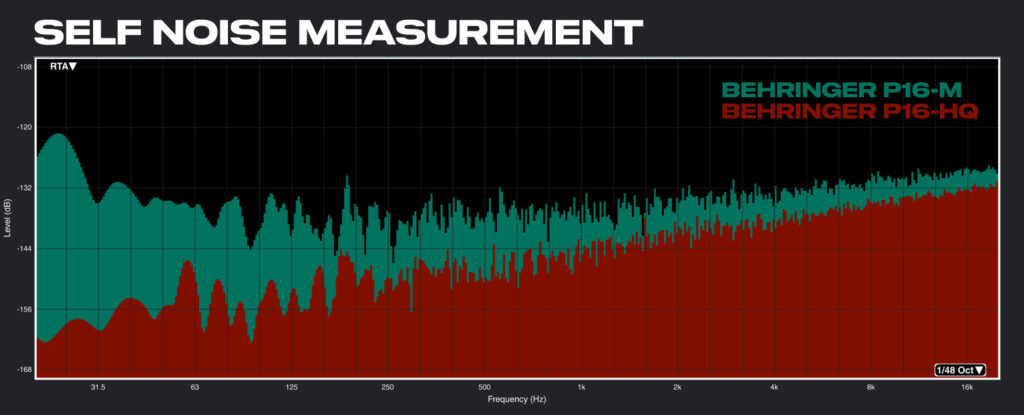
Self-noise comparison – Behringer P16-M vs P16-HQ
The Behringer P24 performs nearly identically to the P16-HQ on noise floor. This strongly suggests they share the same DAC and headphone amplifier circuitry – more on that in a moment.
The Midas DP48 also performs well here, averaging around -140 dB, which puts it between the P16-HQ and the P16-M. It’s noticeably quieter than the P16-M but not quite as silent as the P16-HQ.
THD: Cleaner Signal Path
I also measured total harmonic distortion by sending a 1 kHz tone through each unit and analyzing the harmonic peaks.
THD Measurements @ 1 kHz:
| Unit | THD | vs P16-M |
| Behringer P16-HQ | 0.0034% | 3x cleaner |
| Behringer P24 | 0.0042% | 2.4x cleaner |
| Behringer P16-M | 0.010% | Reference |
| Midas DP48 | 0.019%* | Around 2x higher |
The Behringer P16-HQ measured about 3x cleaner than the Behringer P16-M in my testing. The Behringer P24 was virtually identical to the P16-HQ – another data point confirming shared audio circuitry.
*The Midas DP48 landed between the P16-M and P16-HQ. One thing to note: the DP48’s THD varied depending on output level. At lower volumes it measured very clean (0.002%), but when pushed to match the P16-M’s output level, distortion increased (0.036%). The DP48’s more complex signal path and dual mix engine architecture may play a role here. Behringer doesn’t publish a THD specification for the DP48, so I don’t have an official number to compare against.
P16-HQ and P24: Confirmed Identical Audio Circuitry
One of my suspicions going into this test was that the Behringer P16-HQ and Behringer P24 might share the same audio circuitry. The measurements confirm this definitively.
Evidence of shared DAC and headphone amplifier:
- Output level: +5.64 dB vs +5.69 dB (within measurement error)
- THD: 0.0034% vs 0.0042% (nearly identical)
- Noise floor: -144.7 dB vs -143.0 dB average (nearly identical)
- Phase response: Nearly identical curves across the frequency spectrum
If you’re deciding between the Behringer P16-HQ and Behringer P24, know that you’re getting the same audio quality. The P24 gives you 8 additional channels and StageConnect connectivity, but the headphone amp feeding your ears is the same.
Frequency Response: All Flat, No Surprises
Good news here: all four units are essentially ruler-flat through the audible range.
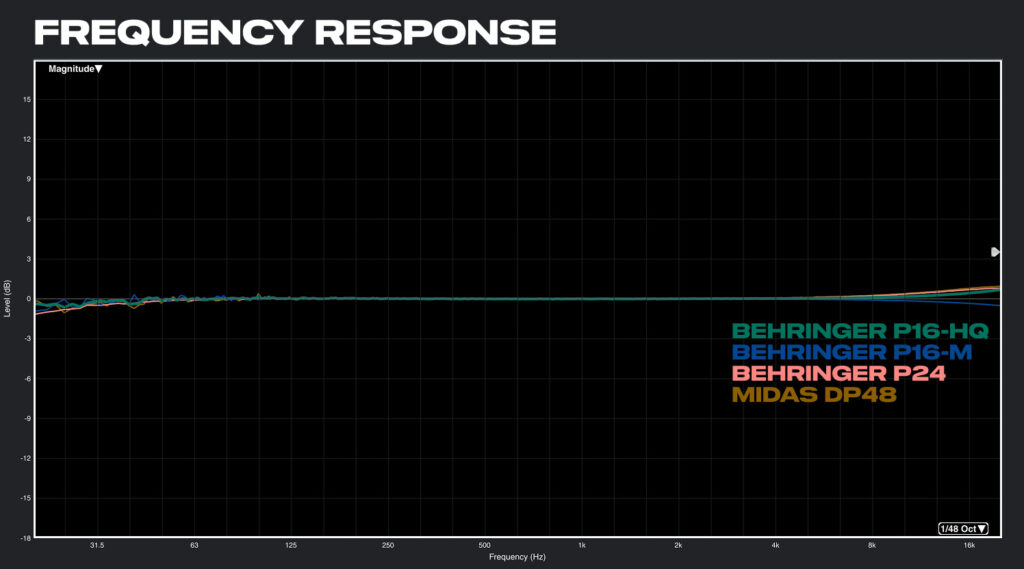
From 100 Hz to 10 kHz, every unit measured within ±0.2 dB. There’s no meaningful tonal difference between them – none of these units are “brighter” or “darker” than the others based on frequency response.
The only subtle differences appear at the extremes. Above 10 kHz, the Behringer P16-HQ and Behringer P24 show a very slight rise (about 0.7 dB by 20 kHz), while the Behringer P16-M shows a slight drop. This equates to a 1.23 dB boost at 20 kHz for the P16-HQ and P24 in comparison to the P16-M.
Phase Response: A Technical Deep Dive
This is where I found something genuinely interesting from an engineering perspective.
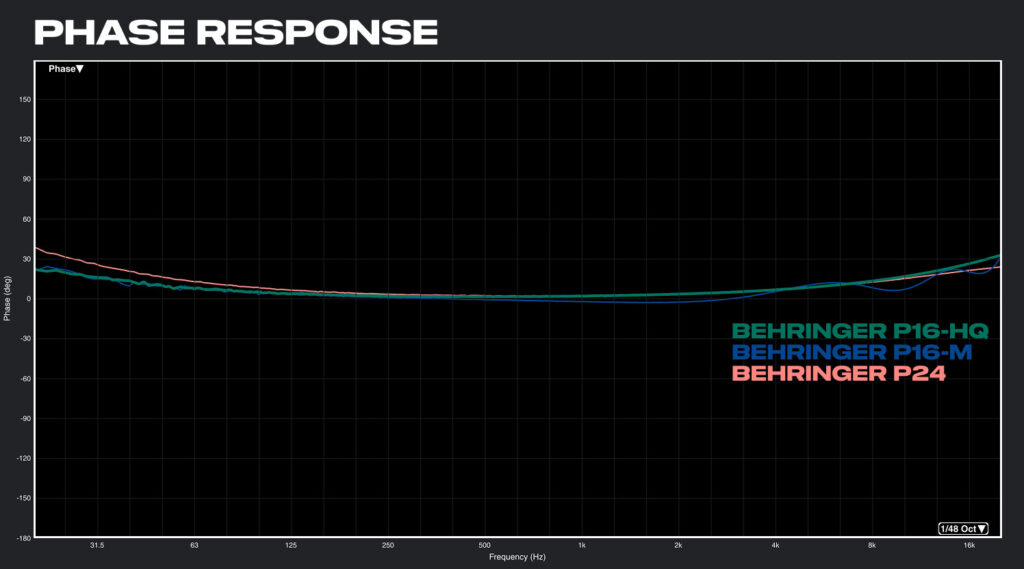
The Behringer P16-M shows a slight phase shift (and I mean slight) – the phase actually dips negative in the midrange (around 500 Hz to 2 kHz) before recovering at higher frequencies.
The Behringer P16-HQ shows a much cleaner, linear phase increase across the frequency spectrum. This is another sign that the “HQ” designation reflects real engineering improvements, not just marketing.
Additionally, the Behringer P24’s phase response is nearly identical to the P16-HQ, further confirming shared circuitry.
Midas DP48 Polarity Inversion
Here’s something unexpected: the Midas DP48 appears to have inverted polarity on its headphone output. The phase measurement hovers around ±180° across the entire spectrum, which indicates the output is inverted relative to the input.
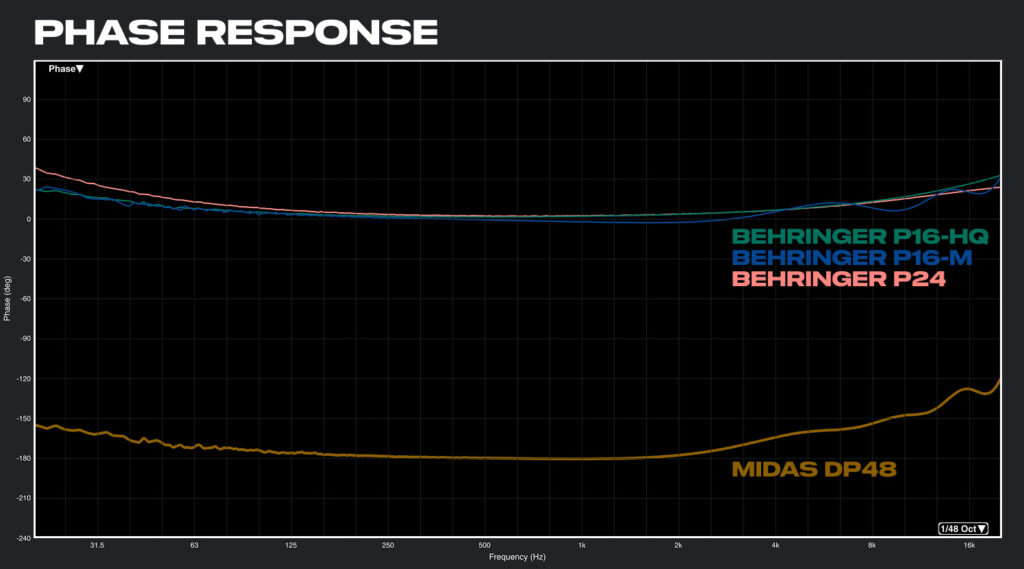
Phase Measurement showing 180° phase shift of the Midas DP48, signifying a polarity shift.
Latency: All Excellent
Every unit measured sub-millisecond latency:
| Unit | Latency | Connection |
| Behringer P16-M | 0.33 ms | Ultranet via SD8 |
| Behringer P16-HQ | 0.33 ms | Ultranet via SD8 |
| Midas DP48 | 0.48 ms | AES50 Direct from WING |
| Behringer P24 | 0.50 ms | StageConnect from WING |
The difference between the fastest (P16-M at 0.33 ms) and slowest (P24 at 0.50 ms) is 0.17 ms – completely imperceptible. All four units are excellent for in-ear monitoring from a latency perspective and in comparison to a floor monitor that is a few feet away from a musician, the personal mixers would be faster in time.
What Should You Buy?
Here’s how I’d break down the decision:
Behringer P16-HQ – If you want the cleanest audio quality in a 16-channel Ultranet personal mixer, this is it. The noise floor and THD improvements over the P16-M are real and measurable. If you’re building a new system or replacing aging P16-M units, the P16-HQ is the way to go.
Behringer P24 – If you need more than 16 channels, get this. You’re getting the exact same audio quality as the P16-HQ with 8 additional channels and StageConnect flexibility. There’s no audio quality sacrifice for the extra channels.
Behringer P16-M – You will have to find them used, but it is still a capable unit, especially if you already own them. The noise floor is measurably higher and THD is about 3x worse than the P16-HQ, but it’s not “bad” by any means. If budget is extremely tight or you’re just adding one unit to an existing P16-M system, it still works.
Midas DP48 – Buy this for the features. The dual independent mix engines are genuinely useful – musicians can create completely separate mixes for rehearsal versus performance, or split stereo monitoring however they want. The 48 channels and AES50 connectivity are valuable for larger systems. Audio quality is solid – the noise floor is quieter than the P16-M – but if pure audio specs are your priority, the P16-HQ or P24 edge it out.
The Bottom Line – Behringer P16-HQ vs P16-M
The “HQ” in Behringer P16-HQ isn’t marketing fluff. It’s a measurably better personal mixer than the P16-M – 12 dB quieter noise floor, 3x lower distortion, and cleaner phase response from an improved DAC design.
The Behringer P24 shares that same premium audio path, so if you need more channels, you’re not sacrificing quality to get them.
And for anyone who’s been running P16-M units for years and wondering if it’s worth upgrading to the Behringer P16-HQ – the answer is yes, particularly if your musicians are using sensitive IEMs and notice noise during quiet passages. That’s exactly where the P16-HQ’s improvements matter most. The other huge benefit is that the P16-M and P16-HQ can be used at the same time, in the same system, interchangeably.
YouTube Video
[EMBED YouTube Video]